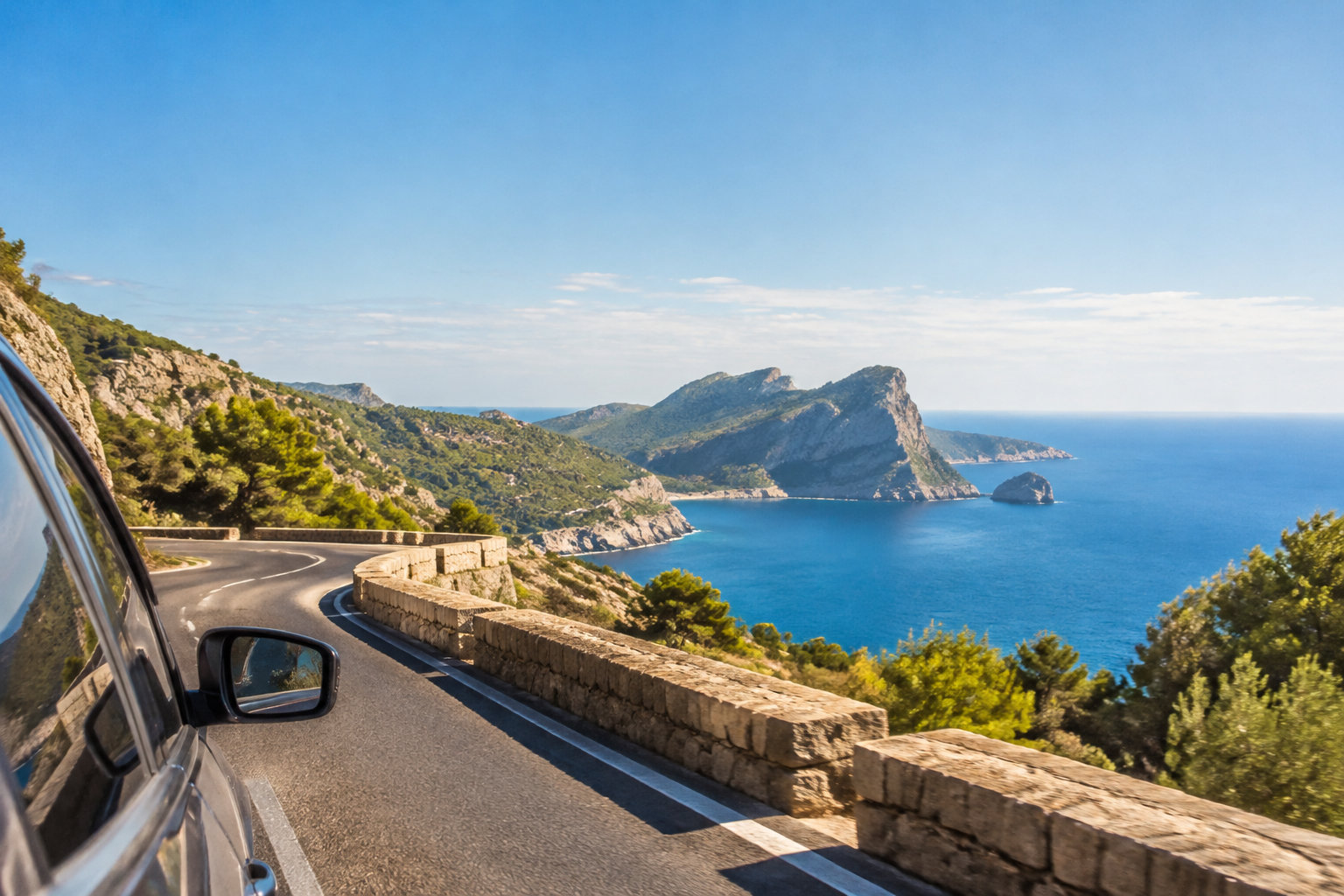
Mallorca looks small on a map. On the road, it often feels much bigger.
Narrow mountain bends and tight streets can turn a simple drive into a stressful one. Here are the essential driving tips in Mallorca for foreigners.
Bring the Right Licence and Rental Documents
Your Licence Must Be Valid in Spain
A valid EU driving licence is recognised in Spain, and UK travel advice confirms you can drive with a valid UK photocard licence. Carry the original physical licence, not a digital copy. Check that it stays valid for your whole trip.
Provisional licences and temporary certificates are not automatically recognised abroad.
Licences issued outside the EU may also need an International Driving Permit. The permit does not replace the original licence.
Documents to Bring and the Rental Conditions to Check
-
EU or UK licence
Bring your original valid photocard licence and identity document. The licence must meet the rental company’s minimum experience requirement.
-
Licence from outside the EU
Bring your original licence, identity document and, where required, an International Driving Permit. Check whether the licence uses a recognised alphabet and whether a translation is needed.
-
Additional driver
Bring your original identity document and driving licence. Add the person to the contract before they drive.
Check the Deposit and Cover Before You Pay
Airport rental offers in Mallorca often include full insurance with no excess. The required deposit can stay below €300. Confirm the exact amount for your chosen vehicle before you book.

The deposit is usually held or pre-authorised on the main driver’s card. Make sure the card belongs to the main driver, has enough funds and stays valid until the rental ends.
An additional driver must be added to the contract before driving.
All-risk insurance with no excess, debit cards accepted (except Electron and Maestro) and a deposit of €160 with Go Keyless or up to €300 with Go Classic. Save 10% with the code MALLORCA10. See our Offugo offer →
Affiliate partner: we may earn a commission at no extra cost to you.
Mountain Roads Take Longer Than They Look
The Serra de Tramuntana has narrow roads, blind bends and steep slopes. Slow down before each bend. Keep to your side of the road. Use passing places instead of forcing another driver towards the edge.
Distances look short on a map. Mountain roads, traffic and parking all add time. Treat these figures as planning guides, not guaranteed arrival times.
| Route | Approximate driving time | Planning point |
|---|---|---|
| Palma to Sóller through the tunnel | About 30 to 40 minutes | The scenic mountain route takes longer |
| Palma to Alcúdia | About 45 to 60 minutes | Allow extra time near beaches and resort areas |
| Palma to Cap de Formentor | About 75 to 90 minutes | The final section may be regulated |
| Palma to Sa Calobra | About 1 hour 30 to 2 hours | The last mountain section is slow and requires a return trip |
In 2026, private vehicles were restricted from 15 May to 18 October, between 10:00 and 22:00, according to the DGT. Check the Consell de Mallorca page before you travel, as dates change every year.
Access to Formentor changes by season. Authorised vehicles, public transport, cyclists and walkers can use the road under the stated conditions.
Prefer not to drive the mountain roads? See the north coast from the sea on our sunrise dolphin-watching trip from Alcúdia, towards Cap de Formentor, or reach Sóller with this vintage train and boat tour.
Follow the Speed Limits and Local Rules
Use the Signed Limit as Your Guide
For cars, Spain’s general speed limits are:
- 120 km/h on motorways and dual carriageways
- 90 km/h on conventional roads
- 50 km/h on urban roads with two or more lanes in each direction
- 30 km/h on urban roads with one lane in each direction
- 20 km/h on roads where the carriageway and pavement share one level
Signs can impose lower limits, particularly in mountain areas and towns.
Mallorca uses fixed and mobile speed cameras. Speeding fines range from €100 to €600. The more serious offences also carry two to six penalty points.
Your hire company may also charge an administration fee when it receives a fine linked to your contract.

Traffic already on a roundabout has priority. To leave, use the outer lane, signal your exit and watch for cyclists.
At ordinary junctions, follow the signs and road markings. Do not assume you have priority.
Keep Every Passenger Secured
Seat belts are compulsory in every occupied seat.
Children must use an approved child restraint until they are taller than 135 cm. They should normally travel in the rear seats, unless a legal exception applies.
Holding a phone or navigation device while driving can lead to a €200 fine and six penalty points. Reading messages, wearing headphones or handling a device can also be sanctioned.
Set your route before you move off. Use a proper hands-free system.
The standard alcohol limit is 0.5 g/l in blood, or 0.25 mg/l in exhaled air.
New drivers and professional drivers have a lower limit. It is 0.3 g/l in blood, or 0.15 mg/l in exhaled air.
The safest approach is to avoid alcohol before driving. This matters most on unfamiliar mountain roads.
Choose the Right Car and Plan Your Parking
Pick a Car You Can Handle
A small car is easier to position on narrow mountain roads. If you are not comfortable changing gear on steep climbs, choose an automatic. Confirm the vehicle size before booking if you are travelling with several suitcases.
Parking in Palma

Blue ORA spaces are paid parking. They run Monday to Friday from 09:00 to 14:30 and 16:30 to 20:00, and on Saturdays from 09:00 to 14:30, according to the official ORA page.
Outside those periods, a ticket is generally not required. The sign beside the space takes priority, including on Saturday afternoons and Sundays.
ORA prices depend on the zone. Current municipal tariffs are:
- Zone 1: €0.85 for 30 minutes, €1.45 for one hour, up to €2.65 for two hours
- Zone 2: €0.65 for 30 minutes, €2.35 for two hours
- Zone 3: up to three hours, costing up to €2.10
Palma has 16 public underground car parks with around 4,500 spaces. They include Plaça d’Espanya, Plaça Major, Comtat del Rosselló and Passeig Mallorca. Check the tariff and height limit before you enter.
Avoid green spaces unless a sign permits visitor parking. Never stop on yellow markings.
Before you book, confirm the exact deposit for your chosen car and make sure the card that will hold it belongs to the main driver. If Formentor is on your itinerary, check the Consell de Mallorca page for current access rules, since the regulated period can change from season to season.
FAQ
How long does it take to drive around Mallorca by car?
A complete loop of the island covers roughly 300 to 340 kilometres.
Non-stop, plan six to seven hours, but a practical trip with stops usually needs several days because of mountain roads.
Is it a good idea to rent a car in Mallorca?
Yes, if you want to explore the mountains, the north coast or beaches outside Palma at your own pace.
If you stay mainly in Palma, a car is less useful, since parking there is paid and limited.
Is it difficult to drive in Mallorca?
Not especially on motorways, but mountain roads and tight streets demand full attention.
Drive slowly on the Serra de Tramuntana and in Palma’s old streets, and allow extra time for every journey.
Get our Mallorca Ultimate Guide for the best coves, viewpoints and villages, and read our 15 best beaches in Mallorca. In Palma, leave the car and join our Old Town Walking Tour.
Some links in this article are affiliate links. If you book through them, Palma Tour Mallorca may receive a commission at no extra cost to you.
Leave a Reply